
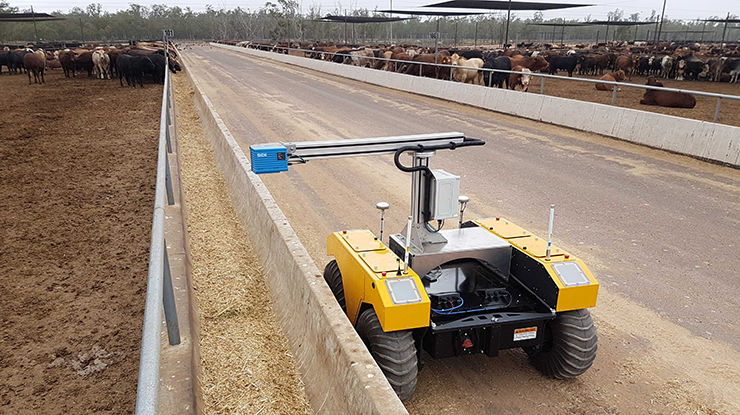
Industrial automation increasingly requires systems that can operate beyond paved roads and controlled facilities. From remote mine sites and agricultural fields to wetlands and winter test grounds, teams need mobile platforms that combine durability, payload capacity, and seamless integration with robotics software. Warthog UGV is designed to meet this demand, serving as a field-ready unmanned ground vehicle that supports both industrial environments and advanced research initiatives.
In this blog, we will review Warthog’s platform specifications and how it can support your industrial automation and outdoor research projects.
Platform Key Specifications
Warthog UGV is a large all-terrain unmanned ground vehicle built for demanding industrial and research environments. With a 272 kg (600 lb) payload capacity, top speed of 18 km/h, and rugged steel and aluminum construction rated to IP65, it is designed to operate where conventional vehicles struggle. High-traction tires, low ground pressure, and optional track and turf-tire configurations allow it to move confidently across mud, snow, soft soil, and steep grades.
Warthog also uses an articulating, mechanically simple suspension with bogie-like subframes on each side that pivot relative to the central chassis, allowing it to adapt to uneven terrain. This design keeps more wheels in contact with the ground for improved traction and stability off-road, while remaining reliable and low-maintenance in harsh environments.
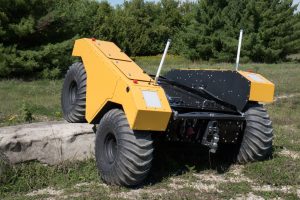
An onboard PC comes preinstalled with ROS 2, and a Gazebo simulation model supports virtual testing before field deployment. Powered by a 48V battery system with optional lithium upgrade for up to eight hours of runtime, Warthog also provides fused 5V, 12V, 24V, and 48V outputs for sensors and heavy equipment, along with flexible mounting plates and reconfigurable I/O for integration.
Mining and Resource Extraction
In mining and resource extraction, terrain instability and safety risks often limit where personnel and traditional vehicles can operate. Warthog functions as a remote transport and inspection platform, carrying LiDAR units, mapping systems, and heavy tools across loose gravel, debris, and uneven grades. Its high payload capacity and drivetrain traction allow it to move industrial-grade equipment reliably, while the optional trailer hitch supports towing additional gear. By shifting transport and inspection tasks to an unmanned platform, operators reduce worker exposure to hazardous zones and maintain continuity in remote sections of a site.
Agriculture and Forestry
Agricultural and forestry environments present different challenges, including soil compaction, wet ground, and weather conditions. Warthog’s low ground pressure helps minimize disturbance to fields and sensitive land, while maintaining mobility in mud or snow. It serves as a stable base for precision agriculture sensors, autonomous spraying systems, and crop monitoring payloads. In forestry and cold-region research, its ability to traverse snow and briefly ford shallow water expands operational windows beyond what typical wheeled equipment can manage. The battery upgrade options offer extended runtimes to support long missions without frequent charging breaks.
Environmental Monitoring and Field Research
Environmental monitoring projects often require reliable equipment in wetlands, protected ecosystems, or harsh climates. Warthog’s sealed electronics and durable chassis withstand outdoor exposure, while its multiple power outputs enable simultaneous operation of atmospheric sensors, soil probes, cameras, and communications systems. Researchers use it for long-duration field deployments where low ecosystem impact and dependable mobility are critical. The platform’s adaptability allows teams to modify sensor configurations as study requirements evolve, without replacing the base vehicle.
Robotics R&D and Autonomous Systems Development
For robotics research and development teams, Warthog bridges the gap between simulation and field validation. With ROS 2 preinstalled and supported by a Gazebo 3D model, developers can test autonomy stacks virtually before deploying outdoors. The reconfigurable I/O and accessible power ports simplify integration of robotic manipulators, AI-driven inspection systems, and experimental hardware. This shortens development cycles and enables rapid iteration under real-world conditions, helping research groups and commercial developers transition from prototype to operational system efficiently.
Payload Integration and Autonomous Navigation
Beyond third-party sensor integration, we also offer OutdoorNAV, outdoor autonomous navigation software, for teams seeking full-site automation. This enables waypoint navigation, obstacle avoidance, and repeatable route execution across large, unstructured environments. Together, this combination allows organizations to move from remote operation to fully autonomous workflows, increasing consistency, reducing labor demands, and improving safety across industrial work sites.
A Platform Designed for Real-World Impact
Across these applications, the core advantages remain consistent. Warthog provides a rugged, extensible robotic foundation capable of carrying substantial payloads through terrain that limits conventional vehicles. Whether transporting equipment in a mine, automating crop monitoring, collecting ecological data, or validating autonomous systems, it supports safer operations, reliable mobility, and scalable integration for industrial automation and applied research.
Learn more about Warthog and contact our team to get started.