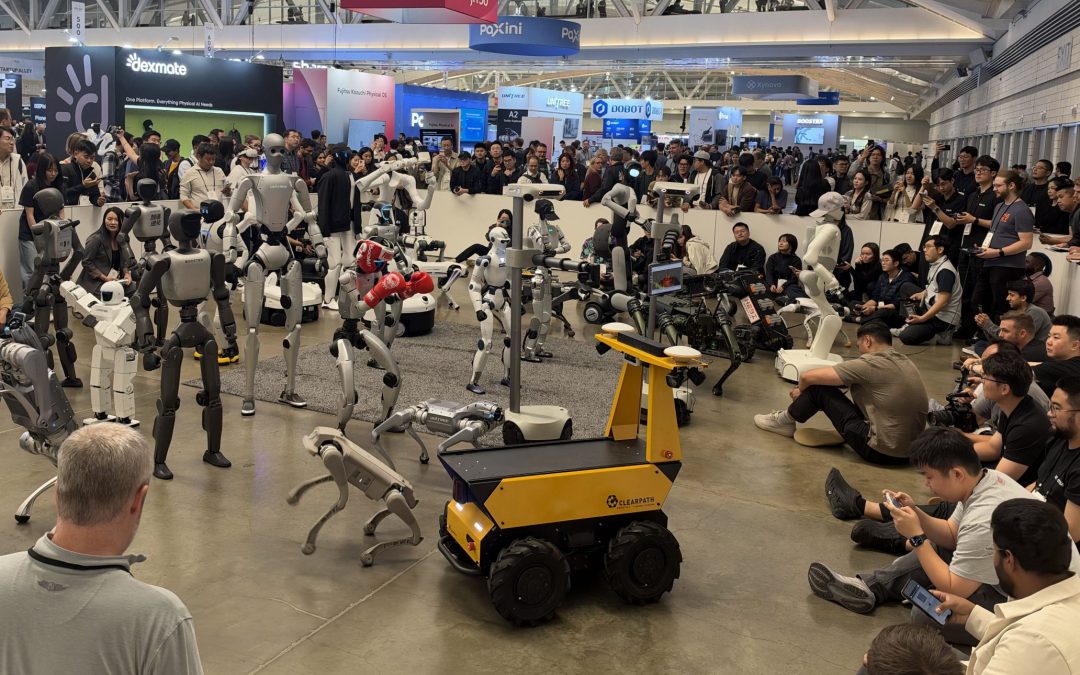
At IROS 2026, we were proud to see multiple presented research papers propelling the robotics field while using our platforms, Husky and Jackal. In this blog, we are spotlighting six of these papers that showcase innovative approaches to real-world challenges such as disease detection in agriculture, robust localization in degraded environments, safety-critical robot navigation, large-scale embodied learning, and heterogeneous robot teaming powered by generative AI. These projects demonstrate the flexibility of Husky and Jackal as trusted platforms for developing, testing, and validating robotics research.
Heterogeneous Robot Collaboration in Unstructured Environments with Grounded Generative Intelligence
Authors: Zachary Ravichandran, Fernando Cladera, Ankit Prabhu, Jason Hughes, Carlos Nieto-Granda, Varun Murali, Camillo Taylor, George J. Pappas, Vijay Kumar
Organizations: Texas A&M University, U.S. Army Research Laboratory, GRASP Laboratory at the University of Pennsylvania
Platform Featured: Husky, Jackal
Abstract: While heterogeneous teams have typically been designed for well-specified missions with known semantics, generative intelligence, i.e., large language models (LLMs) and vision language models (VLMs), opens the possibility of teams that infer mission-relevant semantics and subtasks given high-level natural language specifications and environmental context. However, current LLM- and VLM-enabled teaming methods typically assume well-structured and known environments, limiting performance in complex real-world settings. We address these limitations via SPINE-HT, a framework that grounds the reasoning abilities of LLMs in the evolving context of a heterogeneous robot team through a three-stage process. Given mission specifications and team capabilities in natural language, an LLM infers necessary subtasks. These subtasks are validated for feasibility and then assigned to robots based on capabilities such as traversability or perception. Finally, the framework uses feedback (semantic maps and task outcomes) acquired by the robots to update subtasks online. In simulation experiments with closed-loop perception and control, our framework achieves nearly twice the success rate compared to prior LLM-enabled heterogeneous teaming approaches. In real-world experiments with a Clearpath Jackal, a Clearpath Husky, a Boston Dynamics Spot, and a high-altitude UAV, our method achieves an 87.5% success rate in missions requiring reasoning about robot capabilities and refining subtasks with online feedback.
Read more: https://arxiv.org/abs/2510.26915
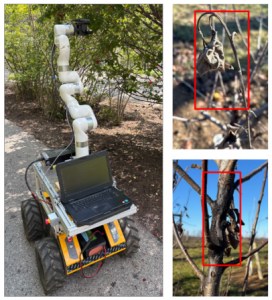
Active Robotic Perception for Disease Detection and Mapping in Apple Trees
Authors: Hayden Feddock, Francisco Yandun, Srđan Aćimović, Abhisesh Silwal
Organizations: Robotics Institute at Carnegie Mellon University, Department of Plant Pathology at Virginia Polytechnic Institute and State University
Platform Featured: Husky
Abstract: Large-scale orchard production requires timely and precise disease monitoring, yet routine manual scouting is labor-intensive and financially impractical at the scale of modern operations. As a result, disease outbreaks are often detected late and tracked at coarse spatial resolutions, typically at the orchard-block level. We present an autonomous mobile active perception system for targeted disease detection and mapping in dormant apple trees, demonstrated on one of the most devastating diseases affecting apple today — fire blight. The system integrates flash-illuminated stereo RGB sensing, real-time depth estimation, instance-level segmentation, and confidence-aware semantic 3D mapping to achieve precise localization of disease symptoms. Semantic predictions are fused into the volumetric occupancy map representation enabling the tracking of both occupancy and per-voxel semantic confidence, building actionable spatial maps for growers. To actively refine observations within complex canopies, we evaluate three viewpoint planning strategies within a unified perception-action loop: a deterministic geometric baseline, a volumetric next-best-view planner that maximizes unknown-space reduction, and a semantic next-best-view planner that prioritizes low-confidence symptomatic regions. Experiments on a fabricated lab tree and five simulated symptomatic trees demonstrate reliable symptom localization and mapping as a precursor to a field evaluation. In simulation, the semantic planner achieves the highest F1 score (0.6106) after 30 viewpoints, while the volumetric planner achieves the highest ROI coverage (85.82\%). In the lab setting, the semantic planner attains the highest final F1 (0.9058), with both next-best-view planners substantially improving coverage over the baseline.
Read more: https://arxiv.org/abs/2603.23112
FIRE-LIVWO: Robust LiDAR-Inertial-Visual-Wheel Odometry via Failure-Immune mmWave Radar Enhancement
Authors: Kun Hu, Menggang Li, Kaidi Wu, Zhiwen Jin, Yingjie Zhao, Chaoquan Tang, Eryi Hu, Gongbo Zhou
Organizations: China University of Mining and Technology
Platform Featured: Husky
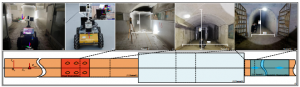
Abstract: Achieving robust SLAM in large-scale underground coal mines with complex structures and severe degeneracies remains highly challenging. Dense smoke and dust cause substantial loss of visual information and degrade LiDAR point-cloud features, while long, self-similar corridors induce geometric degeneration, leading to pronounced odometry drift. To address these issues, we propose FIRE-LIVWO: Failure-Immune mmWave Radar-Enhanced LiDAR-Inertial-Visual-Wheel Odometry, a tightly coupled multi-modal odometry framework based on an iterated error-state Kalman filter (IESKF). The framework fuses 4D mmWave radar, LiDAR, and visual features within a unified VoxelMap and jointly constructs LiDAR-radar point-to-plane residuals and sparse visual photometric residuals. In smoke-filled environments, we exploit the strong penetration of 4D mmWave radar and introduce pointwise Doppler velocity constraints to preserve state observability. In geometrically degenerate corridors, we tightly couple wheel odometry using non-holonomic constraints (NHC) and online lever-arm compensation to reduce drift. Our central contribution is a degeneration detection and adaptive fusion model switching strategy grounded in geometric and visual observability analysis, which quantifies observability online and dynamically adjusts modality weights. Real-world experiments in underground coal mines demonstrate that FIRE-LIVWO accurately identifies failure boundaries, enabling reliable modality switching under extreme conditions. Compared with baselines, it achieves superior accuracy and robustness (average localization error of 5.677m). We open source our code on Github to benefit the robotics community.
Read more: https://arxiv.org/abs/2609.05325
Safety-Constrained Reinforcement Learning with Post-Training Reachability Verification for Robot Navigation
Authors: Qisong He, Xinmiao Huang, Jinwei Hu, Zhuoyun Li, Yi Dong, Changshun Wu, Xiaowei Huang
Organizations: University of Liverpool
Platform Featured: Jackal
Abstract: Safe navigation for mobile robots demands policies that remain reliable under the high-consequence perception uncertainty of cluttered environments. Yet most existing safe reinforcement learning (RL) methods assess safety through average cumulative cost. Such metrics can mask dangerous tail-risk behaviors. To address this, we propose a framework that trains risk-sensitive policies through Conditional Value-at-Risk (CVaR) constrained optimization on an off-policy TD3 backbone and evaluates their safety margins post-training through neural network reachability verification. During training, the policy is optimized under CVaR constraints on cumulative costs, promoting sensitivity to high-cost tail outcomes rather than average behavior alone. After training, we compute action reachable sets under bounded observation uncertainty using Taylor Model analysis, yielding a safety rate metric that quantifies the proportion of evaluated states at which the policy’s reachable action set remains within prescribed safety margins. A key finding is that policies trained with CVaR constraints maintain larger safety margins from obstacles across evaluated states. This makes them significantly more amenable to formal reachability verification. Experiments across ten navigation scenarios and six baselines show that our method achieves a 98.3\% success rate, the highest safety verification rate among all compared methods, while revealing that average cost rankings and reachability-based safety rankings can diverge. This indicates that reachability verification captures risks which are missed by empirical cost metrics alone. We further validate our approach on a physical Clearpath Jackal robot, demonstrating successful sim-to-real transfer.
Read more: https://arxiv.org/abs/2605.14174
Stereo4DWalker: Learning 4D-aware Embodied Urban Navigation from Internet Stereo Videos
Authors: Wentao Zhou, Xuweiyi Chen, Vignesh Rajagopal, Jeffrey Chen, Rohan Chandra, Zezhou Cheng
Organizations: University of Virginia
Platform Featured: Jackal
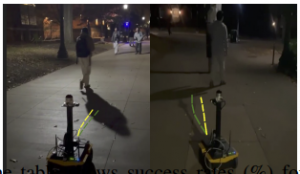
Abstract: Despite rapid progress, embodied navigation in dynamic and unstructured urban environments remains brittle. Most existing approaches directly map monocular visual inputs to actions through end-to-end pixel-to-action training, assuming that accurate spatiotemporal (4D) scene understanding will emerge implicitly. While appealing, this paradigm requires large amounts of pixel-to-action supervision that are difficult to obtain. This challenge is amplified in dynamic, unstructured settings, where robust navigation requires precise 4D scene modeling. To address these limitations, we present Stereo4DWalker, a 4D-aware embodied navigation model that leverages stereo inputs and explicitly builds structured 4D representations of geometry and motion. These 4D structures are integrated into the navigation transformer through simple yet effective 4D-conditioned attention layers. To support scalable training, we curate a large-scale stereo navigation dataset with automatically annotated actions from Internet stereo videos. Our experiments show that Stereo4DWalker surpasses state-of-the-art performance using only 1.5% of the training data, highlighting the effectiveness of explicit 4D visual modeling for data-efficient and robust urban navigation.
Read more: https://arxiv.org/abs/2512.10956
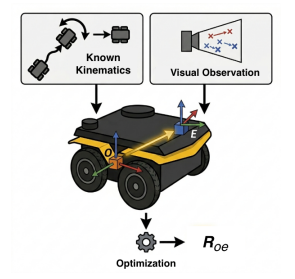
PLS-Calib: A Partial Least Squares Framework for Event Camera and Odometry Calibration under Ground Motion Constraints
Authors: Guangyu Li, Xiao Li, Yujie Wu, Changshuo Wang, Prayag Tiwari, Jiang Cai, Fangwen Yu, Mingkun Xu
Organizations: Guangdong Institute of Intelligence Science and Technology, Institute of Deep-Sea Science and Engineering, Hong Kong Polytechnic University, University College London, Halmstad University, Tsinghua University.
Platform Featured: Jackal
Abstract: Accurate extrinsic rotation calibration between sensors is fundamental to the performance of robotic perception systems. However, most existing calibration techniques rely on full 6-DoF motion to excite all degrees of freedom, which is often infeasible for ground-constrained robots with limited motion capabilities. Recent approaches designed for such restricted settings, such as Canonical Correlation Analysis (CCA)-based methods, suffer from ill-conditioned covariance matrices that lead to numerical instability and suboptimal calibration accuracy. To overcome these limitations, we present a novel rotation calibration framework named PLS-Calib that, for the first time, leverages Partial Least Squares (PLS) regression to model the latent kinematic correlations between asynchronous, heterogeneous sensor streams. Specifically, we apply our method to the calibration of an event camera and an odometry onboard a ground robot. To improve event-based pattern detection, we introduce a polarity-aware event representation, which enhances spatiotemporal contrast in circular calibration targets. Our PLS-based formulation yields a closed-form, stable solution that avoids matrix singularities inherent in CCA-based approaches. Extensive experiments on both synthetic and real-world datasets validate the effectiveness of our approach, demonstrating significant improvements in calibration robustness and accuracy over state-of-the-art methods. This work offers a practical and theoretically grounded solution for rotation calibration in constrained robotic systems and opens up new directions for applying statistical learning techniques in neuromorphic vision.
Read more: https://arxiv.org/abs/2608.03296