
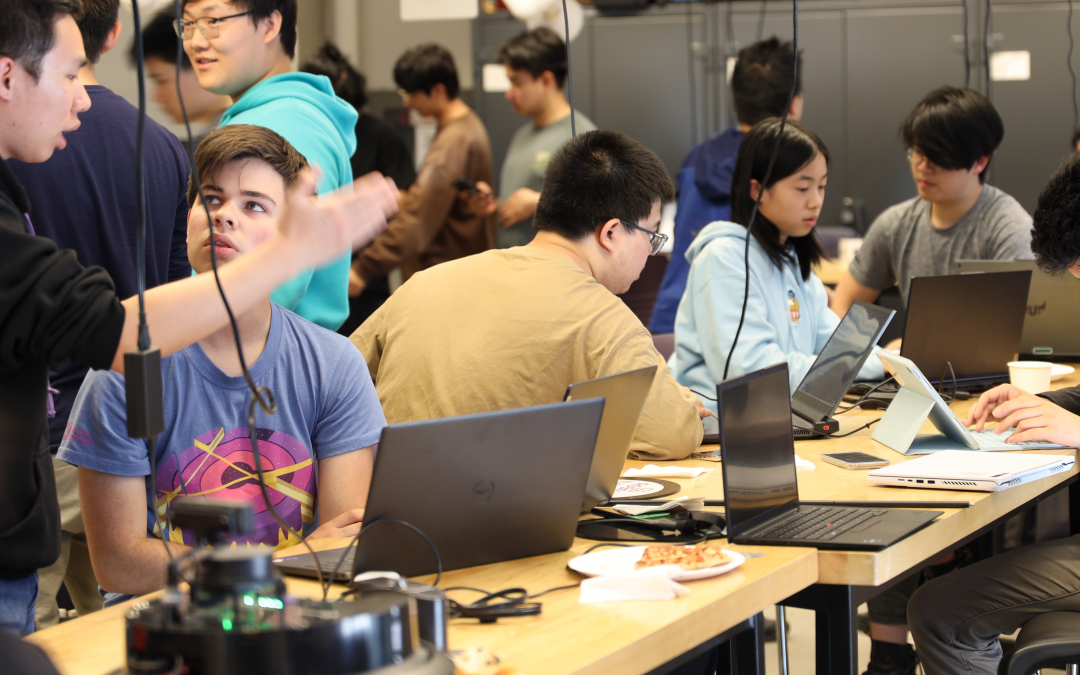
At Clearpath Robotics by Rockwell Automation, we work closely with universities shaping the next generation of roboticists. University of Waterloo (UW) is a prime example as students are supported by the RoboHub, IDEAS Clinic, and ongoing partnership with Clearpath Robotics and Open Robotics.
TurtleBot 4 is widely used in courses, labs, workshops, and student projects at UW. These programs emphasize working with real robots early on, rather than relying only on theory or simulation. TurtleBot 4 fits well into this approach by making it easy for students to test ideas on real hardware while remaining affordable and accessible for teaching and prototyping.
Bringing Robotics Concepts to Life
At the University of Waterloo, TurtleBot 4 is often a student’s first experience working with a real mobile robot. With simple Python-based control and an out-of-the-box ROS 2 setup, students can start driving the robot, reading sensor data, and experimenting with autonomy right away. Because the robot includes both LiDAR and depth cameras, students are exposed to real sensing challenges — noise, uncertainty, and physical constraints — that don’t exist in simulations. This immediate feedback helps demystify robotics and keeps students engaged.
As students progress, TurtleBot 4 becomes a flexible platform for exploring the full mobile robotics pipeline. At UW, it is used to teach and experiment with topics such as:
- Motion and system modeling
- Sensing and perception
- State estimation and filtering
- Localization and mapping
- Planning, navigation, and control
The robot’s simple mechanical design makes it easy for students to understand how commands translate into motion, while its onboard computer and sensors support more advanced algorithms. Since TurtleBot 4 runs a full ROS 2 stack, students gain experience with the same tools and workflows used in research labs and industry.
Built for Real Classrooms and Large Cohorts
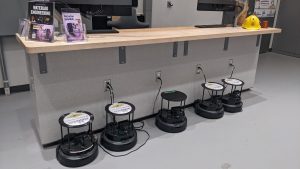
Like many universities, the University of Waterloo must support large class sizes while working within practical budget constraints. TurtleBot 4’s affordability and durability make it possible to deploy multiple robots at once, allowing students to work individually or in small groups instead of waiting for access to a single shared platform. From an instructor’s perspective, this also means less time spent maintaining hardware and more time focused on teaching. The platform is designed to be reliable across repeated terms, helping ensure consistent learning experiences year after year without recurring expenses.
The TurtleBot 4’s compact size and lightweight design make it well suited for classrooms, labs, and workshops. Students can operate the robot safely with minimal supervision, which lowers the barrier to hands-on experimentation and reduces the overhead of managing risk in teaching spaces. This makes the platform appropriate for a wide range of learners, from students new to robotics to advanced undergraduates and graduate researchers.
“The platform was instrumental in our Toyota Innovation Challenge where undergraduate students learned about the complexities of controlling fleets of robots in modern automotive manufacturing environments through hands-on development and validation.” – Chris Rennick, P. Eng, Engineering Educational Developer, University of Waterloo IDEAs Clinic
Supporting Educators Beyond the Hardware
We know that hardware is only part of a successful education program. That’s why we support the broader robotics education ROS ecosystem through documentation, open-source software, and shared learning resources built around TurtleBot 4.
“The TurtleBot 4 gives students hands-on exposure to industry-relevant robotics technologies, including autonomous navigation, sensing, and ROS 2 development, while building the practical, job-ready technical skills that employers increasingly seek in robotics, automation, and software engineering roles.” – Chris Rennick, P. Eng, Engineering Educational Developer, University of Waterloo IDEAs Clinic
Our collaboration with institutions like the University of Waterloo helps ensure that educators can spend less time building infrastructure and more time helping students connect theory with real-world robotics.

Preparing Students for What Comes Next
By using TurtleBot 4, institutions like the University of Waterloo give students early, meaningful exposure to autonomous mobile robotics. Students can see the real-world impact of their code, build intuition through experimentation, and transition smoothly from introductory concepts to advanced robotics workflows.
TurtleBot 4 was designed to grow with learners, and at UW it serves as a foundation for developing the skills students need for research, industry, and beyond.
Check out our TurtleBot 4 Standard and Lite models, or contact one of our distributors to get your order started.