
The world’s top robotics minds are gathering at ICRA 2026 in Vienna, Austria in June, and we’re proud to see Clearpath robots helping drive the research conversation. From novel applications in autonomous navigation to advancements in human-robot interaction, researchers worldwide are using our robots to explore a range of challenges and solutions in the field. In this blog post, we highlight some of the accepted papers offering a closer look at how Clearpath robots are being used to propel robotics research.
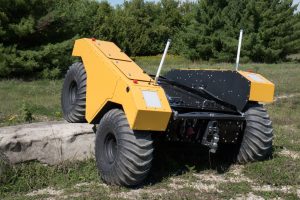
Far-Field Image-Based Traversability Mapping for a Priori Unknown Natural Environment
Clearpath Platform: Warthog
Application: forest navigation and mapping
While navigating unknown environments, robots rely primarily on proximate features for guidance in decision making, such as depth information from lidar or stereo to build a costmap, or local semantic information from images. The limited range over which these features can be used may result in poor robot behavior when assumptions about the cost of the map beyond the range of proximate features misguide the robot. Integrating far-field image features that originate beyond these proximate features into the mapping pipeline has the promise of enabling more intelligent and aware navigation through unknown terrain. To navigate with far-field features, key challenges must be overcome. As far-field features are typically too distant to localize precisely, they are difficult to place in a map. Additionally, the large distance between the robot and these features makes connecting these features to their navigation implications more challenging. We propose FITAM, an approach that learns to use far-field features to predict costs to guide navigation through unknown environments from previous experience in a self-supervised manner. Unlike previous work, our approach does not rely on flat ground plane assumptions or range sensors to localize observations. We demonstrate the benefits of our approach through simulated trials and real-world deployment on a Clearpath Robotics Warthog navigating through a forest environment.
Fahnestock, Ethan – MIT
Fuentes, Erick – Massachusetts Institute of Technology
Prentice, Samuel – Massachusetts Institute of Technology
Vasilopoulos, Vasileios – Samsung Research America
Osteen, Phillip – U.S. Army Research Laboratory
Howard, Thomas – University of Rochester
Roy, Nicolas – Massachusetts Institute of Technology
SPLC: Social Preference Learning for Crowd Robot Navigation
Clearpath Platform: TurtleBot 4
Application: human-robot navigation and interaction
Offline reinforcement learning (RL) holds significant potential for crowd robot navigation in human-robot coexistence applications. However, the inherent complexity of pedestrian motion renders the design of effective reward functions for promoting socially compliant robot behaviors a persistent challenge. This paper proposes a Social Preference Learning for Crowd Robot Navigation (SPLC) algorithm to eliminate the need for detailed reward design. Its core innovation lies in the introduction of a social preference feedback mechanism to automatically generate preference data through principled preference evaluation criteria. By explicitly accounting for the intricacies of pedestrian dynamics, the pipeline mitigates the reward bias and facilitates the systematic quantification of broad social norms, thereby fostering socially compliant behaviors. Extensive experiments integrating SPLC with offline RL methods demonstrate consistent improvements over state-of-the-art baselines across standard performance metrics. Furthermore, real-world experiments on the TurtleBot4 further validate the effectiveness of SPLC in practical human–robot coexistence settings.
Chen, Zixuan – Wuhan University of Science and Technology
Fu, Hao – Wuhan University of Science and Technology
Hu, Haiwen – Wuhan University of Science and Technology
Zheng, Shiquan – Wuhan University of Science and Technology

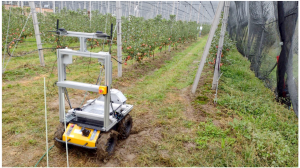
Smooth Human-Robot Shared Control for Autonomous Orchard Monitoring with UGVs
Clearpath Platform: Husky A200
Application: agricultural navigation and human-robot operations
Precision agriculture offers the opportunity to automate routine or difficult tasks in orchards and vineyards, such as spraying or inspection, with Unmanned Ground Vehicles (UGV). In this context, human operators should be kept in the closed-loop control of the robot for safety and reliability. This work is motivated by the challenges of deploying effectively human-robot shared control in the field. First, an asymptotically stable controller must keep the robot on the desired trajectory between rows of trees, whose distance is on the order of the robot’s width. Second, the robot must efficiently avoid static and moving obstacles (e.g. a rock or a human) in its path. Third, the control inputs must not exceed the actuator limits, which can degrade the trajectory tracking performance, cause instability, or damage critical hardware. Finally, in real-life scenarios, user intervention is sometimes required to manage unpredictable situations. To overcome these challenges, we propose and deploy a shared controller that smoothly blends automatic trajectory tracking, collision avoidance, and human commands. At the same time, it guarantees the system is stable and control actions are within the actuator limits at all times. We extensively tested our approach in simulation and field experiments in an apple orchard.
El Bou, Cheikh Melainine – Free University of Bolzano
Focchi, Michele – Università Di Trento
Chang, Michael – Libera Università Di Bolzano
Camurri, Marco – Univeristy of Trento
Von Ellenrider, Karl Dietrich – Libera Università Di Bolzano
We are very excited for these teams and the work they were able to achieve with the help of our robots. It’s great to see the range of applications and ideas coming out of the academic community. We look forward to seeing you at ICRA in a couple weeks!
Check out all the ICRA Technical Program paper submissions.