
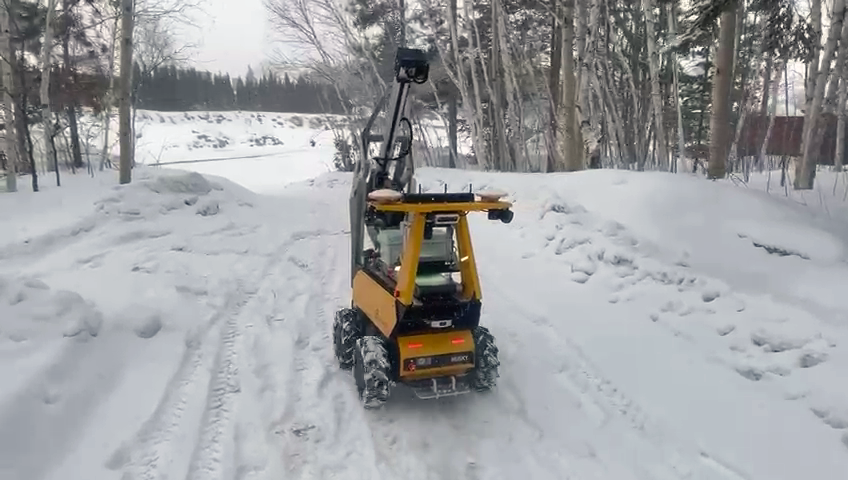
Collecting high-quality soil and geological data in remote, rugged, or hazardous environments has long been a challenge across industries. Whether supporting mineral exploration, environmental monitoring, or agricultural research, traditional sampling methods often require significant manual effort, can expose personnel to difficult field conditions, and may introduce inconsistencies in the data collection process.
To address these challenges, Godelius, in collaboration with Cambrian College, is developed a modular autonomous sampling platform built on the Clearpath Robotics Husky AMP platform. Originally designed with mining applications in mind, the project demonstrates how autonomous mobile robots can streamline data collection workflows, integrate multiple sensing technologies, and provide a flexible foundation for a wide range of outdoor industrial applications.
The project was supported through the Ontario Centre of Innovation’s Centre for Critical Industrial Technologies (OCI-CTI) program and builds upon an established partnership between Godelius and Cambrian College. This collaboration combines complementary strengths from both organizations. Cambrian College contributes research expertise, technical resources, and access to skilled researchers, while Godelius provides extensive experience developing autonomous robotic systems for demanding field environments. Together, the partners have been able to rapidly prototype, integrate, and validate emerging technologies in real-world conditions, accelerating the path from concept to field-ready solution.
Flexible Platform for Field Data Collection
While autonomous soil sampling is often associated with precision agriculture, Godelius recognized a broader opportunity. The team set out to create a modular robotic platform capable of autonomous sample collection and onboard analysis across multiple industries.
Initially developed for mining applications, the platform is designed to collect representative soil and geological samples in locations that may be difficult, time-consuming, or potentially hazardous for personnel to access. By combining autonomous mobility with integrated sensing and analysis capabilities, the system enables organizations to gather more consistent and actionable field data while reducing manual intervention.
Rather than developing a solution for a single application, Godelius focused on creating a platform architecture that can be adapted to different sampling and sensing requirements. The result is a flexible foundation capable of supporting applications ranging from mining and environmental monitoring to agriculture and infrastructure assessment.
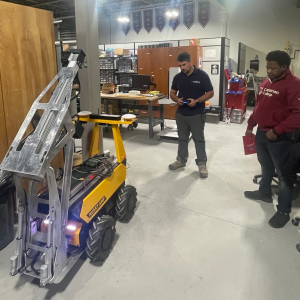
Godelius and Cambrian College representatives driving Husky AMP with integrated soil sampling equipment.
Why Husky AMP?
Selecting the right robotic platform was a critical part of the project. When evaluating robotic platforms, several requirements stood out as essential: mobility, payload capacity, reliability, and proven outdoor performance.
“Husky AMP offers an excellent balance between compact size and rugged performance,” the team explained. “It’s robust enough to carry the payload required for our application while remaining compact enough to operate efficiently in challenging environments.”
The Husky AMP met each of these requirements while offering the flexibility needed for future development. Its compact footprint allows it to access areas where larger vehicles may struggle to operate, while its payload capacity supports the integration of mission-specific equipment without compromising mobility.
For this project, the robot was outfitted with a custom drilling mechanism for sample collection, an onboard conveyor system for transporting samples, cameras for image analysis, and additional sensors based on testing requirements. Since the team already had experience working with Clearpath Robotics platforms, integrating both hardware and software components into the Husky ecosystem was straightforward. Husky AMP allowed them to focus on developing and integrating the sampling and sensing capabilities without having to build a mobile platform from scratch. This allowed the researchers to focus on developing application-specific functionality.
“Having sensors already integrated onto the AMP is helpful, particularly for autonomous navigation. Having the positioning and perception capabilities already available on the platform simplifies the integration process and allows us to focus more of our development efforts on the sampling system and the application-specific capabilities.”
Autonomous Sampling and Onboard Analysis
A typical field mission begins with the robot autonomously following a predefined route, although remote operation remains available when needed. Upon arriving at a designated sampling location, the robot deploys its drilling mechanism to collect a soil sample. That sample is then transferred via an onboard conveyor system where it can be analyzed directly on the platform. Integrated cameras capture images of the material, while AI-based analysis performs an initial characterization of the sample, including functions such as particle size distribution analysis. The system’s modular design also allows additional sensing technologies to be added depending on project requirements. This ability to combine autonomous navigation, automated sample collection, and onboard analysis within a single platform and process significantly streamlines field operations and creates opportunities for faster decision-making.
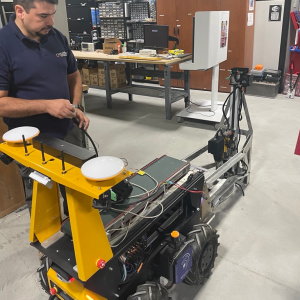
Godelius representative working on Husky AMP with integrated soil sampling equipment.
Improving Productivity, Consistency, and Data Quality
One of the most immediate benefits of autonomous field robotics is the ability to reduce repetitive manual work. By automating navigation and sampling procedures with our OutdoorNAV autonomy software, researchers and technicians can spend less time performing routine tasks and more time analyzing results and making informed decisions. Automated workflows also improve consistency by ensuring that sampling procedures are executed the same way each time, helping reduce variability between operators.
While the project remains in the research and development phase, the team has already achieved a significant milestone: demonstrating that autonomous navigation, automated sampling, and onboard analysis can successfully operate together on a single robotic platform. Perhaps most importantly, the project validated the team’s modular design philosophy. Rather than building a purpose-built system for a single application, they created a flexible architecture capable of evolving alongside new sensing technologies and emerging industry requirements.
The Future of Autonomous Field Robotics
The benefits of autonomous sampling extend beyond mining. In agriculture, consistent and repeatable soil characterization can support more informed decisions around irrigation, fertilization, and crop management. Environmental monitoring organizations can use similar workflows to improve data collection efficiency, while mining operations can gain faster access to critical geological insights.
Looking ahead, Godelius expects autonomous mobile robots to become increasingly common as robotics hardware becomes more affordable, and AI capabilities continue to advance. Rather than replacing existing equipment, these systems are likely to complement traditional workflows by handling repetitive, labour-intensive, and data-intensive tasks.
For organizations exploring autonomous field operations, the team emphasizes the importance of defining operational requirements first and selecting technology second. A successful deployment depends not only on the robot itself but also on the integration of sensing systems, data processing workflows, and software infrastructure. They also stress the importance of maintaining a flexible architecture and validating solutions through extensive field testing under real-world conditions.
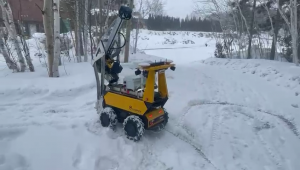
Husky AMP with integrated soil sampling equipment driving outside in the snow.
A Proven Platform for Outdoor Industrial Innovation
As this project demonstrates, Husky AMP provides more than autonomous mobility. Its combination of rugged outdoor performance, payload capacity, compact footprint, and integration flexibility makes it a powerful foundation for organizations developing next-generation field robotics solutions.
Whether supporting mining, environmental monitoring, agriculture, or other industrial applications, Husky AMP enables researchers and technology developers to focus on innovation while building on a proven autonomous mobile robot platform.
Ready to build your next outdoor robotics application? Learn more about Husky AMP and discover how its rugged, flexible architecture can accelerate the development of autonomous industrial solutions. Visit the Husky AMP webpage to explore specifications, capabilities, and integration options.