
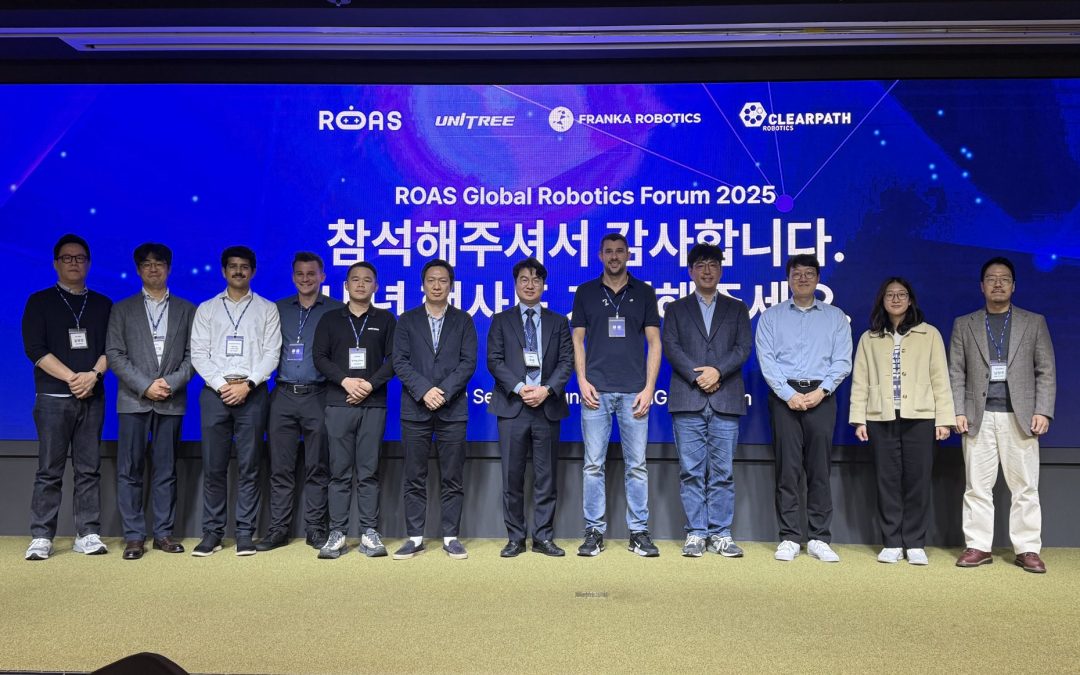
Clearpath Robotics was proud to take part in the first-ever ROAS Global Robotics Forum, hosted by our Korean partner and distributor, ROAS. Centered around the theme “Connecting Global Robotics Ecosystem,” the event brought together more than 200 researchers, industry leaders, and innovators shaping the future of autonomous robots. The program featured keynotes from Clearpath Robotics, Franka Robotics, and Unitree, alongside customer case studies highlighting advanced research made possible by Clearpath platforms. It was an exciting opportunity to engage with the Korean robotics community and celebrate the impact of our global partners.
Beyond the keynote sessions, the event spotlighted four exciting research projects powered by Clearpath platforms. These talks explored advancements in human–robot collaborative manipulation, task-aware semantic planning for home robotics, whole-body motion control for mobile manipulators, and multi-arm coordination in cluttered environments. Together, they showcased how Clearpath robots are enabling researchers to push the boundaries of autonomous manipulation, perception, and intelligent decision-making. Below, we highlight each project in more detail.
Prof. Jinseong Park, Chungnam National University
Mobile Manipulator Application Case for Human-Robot Collaboration Work
Featuring a Husky ground platform with a Franka Research 3 arm, this presentation emphasized the growing need for seamless human–robot collaboration, particularly when handling unfamiliar objects that are too heavy, awkward, or complex for either humans or robots to manage alone. A core challenge discussed was the difficulty of distinguishing human intent from the forces and dynamics introduced by the shared object itself. To address this, the researchers developed a method that enables a robot to estimate key object parameters, such as weight and center of gravity, while the human and robot are jointly holding and manipulating the object. By incorporating accelerated motions for improved inertial estimation and leveraging an object-aware impedance controller, the system can reactively adapt to unknown properties and support intuitive cooperative transfer and task execution.


Prof. Yoonseon Oh, Hanyang University
Task Aware Semantic Mapping and Robot Task Planning for Autonomous Home Robots
The presentation showcased a high-level task planning framework designed to support a Husky ground robot with an integrated Franka manipulator arm to interpret and execute natural-language instructions in complex household environments. At its core is the GNN-Transformer Task Planner (GTTP), which extracts meaningful object and scene features through graph neural networks and leverages a transformer to incorporate historical state information for context-aware decision-making. GTTP predicts the next subgoal, estimates whether it can be executed, and determines when a task is complete — offering interpretable step-by-step plans rather than opaque, end-to-end outputs. To further improve robustness, the system uses semantic-driven data augmentation, including room, category, and property relevance filtering, object sampling, and an LLM-based plan verifier. While the approach still faces limitations — such as the absence of replanning, lower generalization compared with direct LLM-based planners, and no explicit time optimization — ongoing work aims to address these gaps through replanning under partial information, time-efficient planning strategies, and multi-agent extensions.


Prof. Sanghyun Kim, Kyung Hee University
Planning and Learning-Based Humanoid Arms Manipulation Technique
Whole Body Control with Mobile Manipulation
The presentation delved into whole body control strategies that enable mobile manipulators on the Husky ground platform to perform complex tasks with fluidity and safety. By leveraging a Hierarchical Quadratic Programming (HQP) framework, researchers demonstrated how a robot can reactively transition between multiple whole-body objectives — such as balancing, locomoting, and manipulating objects — while continuously respecting joint, torque, and contact constraints. A key focus was on generating precise, coordinated motions using Weighted Hierarchical Quadratic Programming (WHQP), which allows high-priority tasks to be enforced without compromising secondary objectives. The talk also addressed a critical challenge in whole body control: self-collision avoidance. Through the introduction of repulsive forces that dynamically adjust a robot’s configuration, the system can steer joints away from dangerous configurations in real time. Altogether, the approach reveals a robust and scalable way to generate accurate, safe, and adaptive whole body motion for ground-based mobile manipulators.


Prof. Changjoo Nam, Sogang University
Planning and Learning-Based Humanoid Arms Manipulation Technique
Multi-Arm Manipulation
The presenters highlighted research in multi-robot systems aimed at making robots more capable in complex, cluttered environments. This was done with autonomous object-retrieval techniques in which robots intelligently rearrange surrounding items to uncover and grasp a target object, demonstrating planning that goes beyond simple pick-and-place. They also explored coordinated retrieval, where two robotic arms work together to clear clutter more efficiently through shared perception and collaborative motion. They introduced a coordinated object-packing framework that blends hierarchical planning, learning-based models, and search strategies, enabling teams of robots to pack objects tightly and reliably in real-world scenarios. Together these developments, among constrained dual-arm motion planning with the Dingo seen below, and other scenarios not mentioned, point toward a future where multi-robot collaboration becomes seamless, adaptive, and highly effective in everyday tasks.

Thank you ROAS for organizing such a successful event and the opportunity to connect with many great researchers and robotics professionals. We are inspired by the creativity and technical excellence on display by all the presenting groups.
Check out the Husky A300 and our other robotics platforms to accelerate your research project.